Showing posts sorted by relevance for query Washing. Sort by date Show all posts

Tuesday, 15 February 2022

A comprehensive guide to buying a Vacuum Cleaner

Author- Vibhor Shergill (Brother of Sabhyata Shergill)

After the hustle and bustle of the day, it’s one’s home where one finds the sense of absolute respite in. As soon as one steps in, the only desire one has is to have some filling refreshment and spend time with one’s loved ones or take a peaceful nap. This perfect wish of homecoming withers down as one finds belongings covered in a layer of dust and floor lying untidy with some debris scattered in every nook and corner. Instead of spending quality time with loved ones, one often finds oneself mopping the floor and dusting the odds and ends with a dusting cloth to make the home a livable place.

Maintaining the sanitation of home would not have been so much of an issue had cleaning/dusting were a one off event and once done would not require any more effort. However, that is not the case. Keeping the house in a habitable condition is a job in itself and requires continual effort, therefore one typically employs a maid to take care of the various aspects of cleaning.

However, with rising work responsibilities and long, inflexible work hours, one often finds accommodating the maid’s work schedule in one’s work routine an impossible task as majority of maids tend to provide their service late in the morning or in early afternoon, when most of the office-goers would be at their workplace. Additionally, the quality of work done by maids might not be up to one’s liking either. So in this situation what alternative does one have?

Apparently, there is an alternative, rather, a better alternative - A vacuum cleaner.

Now, if you are a frequent visitor to the posts on this blog, you might be probably aware that we take each topic from the grass root level and we will do the same with this post as well. We will begin with the basics first, understand how a vacuum cleaner works. Then, we will discuss the different types of vacuum cleaners available in the market along with the advantages and disadvantages of each. Following which, we will proceed onto discussing how some brands try to cut manufacturing costs and manufacture below par products that have a very short shelf life and require frequent service. After which, we will move onto deciding which are some of the best vacuum cleaners available in the market that are not only made of high-quality durable components but are also efficient in their working and thus offer most value for one’s money.

You might be glad to know that my father works at a company that manufactures home and kitchen appliances like washing machines, refrigerators, vacuum cleaners, air fryers, etc. So, at home, we frequently have a conversation about these appliances, what goes into making them, how some brands try to cut manufacturing costs to increase their profit margin etc.

Today, I will try my best to pass on the knowledge that I have acquired from my father over the years, to you so as to help you make a good buying decision.

So without further a do, let’s begin…

THE BASICS
A vacuum cleaner is a home appliance that relies on the principle of suction of air to collect dust, debris and other fine particles from the floor and other surfaces such as carpets. The movement of particles from one site to the other when pressure difference is created between two sites forms the basis of the working of a vacuum cleaner.
Based on the configuration of components, vacuum cleaners can primarily be classified into two types, namely:-
  1. Bagged Vacuum Cleaners
  2. Bag-less Vacuum Cleaners
Bagged Vacuum Cleaners
This configuration of vacuum cleaners typically makes use of five components to get the entire cleaning operation done. Those are:- An intake hose, An electric motor, A fan, A collecting bag and An exhaust port.

As the vacuum cleaner is turned on, an electric motor starts spinning at high RPMs. The electric motor is attached to a fan that creates low pressure towards the suction side of the intake hose. This pressure is significantly lower than the atmospheric pressure present in the surroundings, and because of the low pressure inside the suction hose, air from the surroundings is sucked into the intake hose, as air moves from area of high pressure to low pressure, thereby taking the dust and debris up the hose towards a collecting bag or a bin.

The collecting bag is made up of porous woven material which acts as an air filter. The pores on the bag typically range between 0.3 to 1.5 micron in diameter thereby trapping all the dust and debris from the air. This relatively clean air makes its way out of the bag into the surroundings through an exhaust port.

In some models, a HEPA filter is also brought into use to further cleanse the air moving out of the collecting bag, before making its way into the surroundings via the exhaust port.
(Image of installation of dust collecting bag in a Bagged Vacuum Cleaner)

Now, having learnt the working of Bagged Vacuum Cleaners, let us proceed to discuss their Pros and Cons.

PROS:-
  • Hygienic. Since all the dust, debris and contaminants get accumulated inside the collecting bag, once full, the user can safely dispose of the bag and replace it with a new one. This is by far the safest and most hygienic method of waste disposal as one does not have to manually clean the mess accumulated in the vacuum cleaner, thereby preventing the potential allergens from making their way back into the air. Furthermore, the bags are airtight in nature, which implies that once dust or debris enter the bag, they can not escape into the surroundings again. This makes bagged vacuum cleaners an ideal choice for families having infants or elderly people at home.
  • Requires less maintenance. The collecting bag of the vacuum cleaner can easily hold up to one week’s worth of dust and debris. Apart from the periodic replacement of collecting bag, bagged vacuum cleaners are virtually maintenance-free appliances.
CONS:-
  • Recurring expenses. Since bagged vacuum cleaners require periodic replacement of collecting bag, this adds up to the operational cost of the vacuum cleaner. Though, the bags are quite inexpensive, over a period of years, the total of initial and operational cost of the vacuum cleaner might go beyond one’s liking. However, in recent times, some vacuum cleaners are being manufactured with reusable collecting bags, where the user just needs to empty the collecting bag after use and re-install it in the vacuum cleaner for next use.
  • Performance dips as bag fills. The suction and cleaning performance of bagged vacuum cleaners are dependent upon the available space inside the collecting bag. When the bag is fresh, one would get the most optimal performance in terms of cleaning efficiency from the vacuum cleaner. However, as the bag starts to fill up with debris, the cleansing performance significantly drops. As a rule of thumb, one should replace the collecting bag once it is filled with dust and debris up to the three-fourth level in order to derive the best performance out of one’s vacuum cleaner.
So, having understood the advantages and disadvantages of Bagged Vacuum Cleaners, let us proceed to analyze the Bag-less Vacuum Cleaners.

Bag-less Vacuum Cleaners
The working principle of bag-less vacuum cleaners is very similar to that of bagged ones, except for the fact that instead of a collecting bag that collects all the dust and debris, bag-less vacuum cleaners make use of a collection bin known as a canister to collect all the mess.

Bag-less vacuum cleaners can be sub-categorized into three types based upon their cleansing mechanism:-
  1. Wet & Dry vacuum cleaners
  2. Cyclone vacuum cleaners
  3. Robotic vacuum cleaners
Wet & Dry vacuum cleaners
This sub-category of bagless vacuum cleaners has a HEPA/special cartridge filter fitted inside the canister which filters out dust and debris before they get accumulated in the canister.

The fan driven by an electric motor creates low pressure towards the suction side of the intake hose. Due to significant difference in the atmospheric pressure and the pressure created by the fan, air along with all the dust and debris gets sucked into the intake hose and moves towards the dust holding canister. The air, free from dust and debris is expelled out of the exhaust port after passing through a HEPA filter that virtually traps all the microscopic and large particles, including allergens and mould before expelling them out through the exhaust port, thereby facilitating sanitized air in the home.

As the name suggests, Wet & Dry vacuum cleaners can work efficiently, both for cleaning dry mess as well as liquid spills. In some models, one might need to remove the HEPA filter when requiring to clean liquid spills, whereas, in others, special wet/dry filter is used which caters to both solid as well as liquid debris simultaneously, thereby not requiring any human effort to add/remove a filter.

In recent years, considering the hygiene factor that the dust collecting bag offers, some manufacturers of Wet & Dry vacuum cleaners have started to offer in their products, a dedicated collecting bag to gather dust, in addition to a canister which is used solely to accumulate liquid mess. Depending upon the specific model, one might need to remove the dust collecting bag when using the vacuum cleaner for cleaning liquid spills.
Related image
(Image of a Wet & Dry Vacuum Cleaner working on liquid mess)

Cyclone vacuum cleaners
Cyclone vacuum cleaners are a very popular choice among buyers. They work on the principle of centrifugal force to eliminate dust and debris from the sucked air.

Air along with dust and debris enters the intake hose pipe because of the low pressure created by the fan. At the other end of the intake hose, air laden with dust and debris encounters a vertical cyclonic separator which is a cylindrical device with a conical bottom. The mixture of air and dirt enters the cyclonic separator from an inlet port located on its wall and travels down the cavity of cyclonic separator at high speeds in a helical fashion. Dust and debris being heavy in comparison to air are unable to follow the helical path and rather strike the walls of the cyclonic separator, thereby losing all the momentum, which results in them falling towards the conical bottom of the cyclonic separator where a canister is attached to collect all the mess.

The air, free from dust and debris reaches towards the bottom of the cavity where it changes its direction and starts moving upwards and finally exits from an outlet port located at the top of the cyclonic separator. This relatively cleaner air is then fed into a HEPA filter which sanitizes it by removing the microscopic contaminants and allergens.

Robotic vacuum cleaners
This category of vacuum cleaners has gained lot of appreciation in the past few years, and perhaps for all the good reasons. Robotic vacuum cleaners rely on their multiple onboard sensors to help them determine the path they are following and the area of the floor they need to clean. One of the onboard sensors, the pizeo-electric sensor, generates electrical impulses when something strikes it, in this case, dust and debris. When dust strikes the pizeo-electric sensor, the sensor directs the robot to move slowly over that region such that dirt can be effectively cleaned. The robot can effectively clean the locations that conventional vacuum cleaners can not, such as, beneath the tables, under the beds, etc.

The greatest advantage of robotic vacuum cleaners comes from the fact that they do not require any sort of human intervention. Once directed to perform the cleaning operation, they autonomously get the job done. Robotic vacuum cleaners work wonders in homes where working members have a hectic work schedule and remain at workplace for most part of the day. However, they are not a substitute to conventional vacuum cleaners and should be used for minor cleaning purposes and for catering to the difficult sites that the conventional vacuum cleaners can not reach. 


(Image of a Robotic Vacuum Cleaner)

Now, having examined the three types of bag-less vacuum cleaners along with their working, let us proceed to discuss the advantages and disadvantages of bag-less vacuum cleaners.

PROS:-
  • Cheaper maintenance. Perhaps the greatest advantage of bag-less vacuum cleaners is the fact that that they do not have any disposable elements which need to be replaced periodically, unlike collection bags in the case of bagged vacuum cleaners. Mess is accumulated in the canister which can be disposed of as and when required. Though, one might need to replace the HEPA filters of bag-less vacuum cleaners from time to time, in most cases, the frequency of requirement of replacement would not be more than once a year.
  • Reusable and washable canister. The canister, unlike collection bags in case of bagged vacuum cleaners can be emptied and washed as per one’s discretion. This functionality facilitates the user to dispose of the mess after every use or as per one’s liking. Whereas, in case of bagged vacuum cleaners, one does not have this liberty. Since collection bags come at a price, one would not want to throw away the bag unless full. Therefore, if one does not wish to store the mess for several days, and desires to get rid of all the litter as soon as the cleaning process is over, bag-less vacuum cleaners provide that facility.
CONS:-
  • Slight exposure to Allergens. As previously discussed, one needs to periodically empty the canister to get rid of the accumulated mess. While emptying the canister, allergens as well as various pathogens in the dust particles might get suspended into the air forming a cloud of dust, which, if regularly inhaled over a period of years may lead to breathing issues. People suffering from asthma and/or other lung diseases should avoid cleaning the canisters.
So, having learnt about the three types of bag-less vacuum cleaners along with their Pros and Cons, let us proceed to discuss the ways in which some manufacturers (names not taken) try to cut manufacturing costs in order to maximize their own profits and in turn deliver a sub-standard product to the customers, the components of which have a very short shelf life and may require frequent servicing.

COST CUTTING TECHNIQUES
  • Low-grade overheating electric motor. The electric motor rotates at very high RPMs to power the fan that creates low pressure inside the intake hose for suction to take place. This makes the electric motor one of the most crucial components of the vacuum cleaner and therefore accounts to almost 30 per cent of the entire cost of the product. Hence, it is one of the favourite areas of some manufacturers to cut costs and increase their profit margins. Some manufacturers resort to using a below-par electric motor that is not powerful enough to keep the fan rotating at high speeds for long periods of time. After only a few minutes of use, these electric motors tend to get extremely hot. As you might be aware that metals expand on heating, which causes the copper windings in the motor to initially distort and then finally melt, thereby leaving the vacuum cleaner unit out of operation. Cost of repairing the motor might range from a few hundred bucks to more than a thousand bucks and this process is recurring.
  • Inefficient rubber gasket and seals. To facilitate airtight operation so as to prevent dust and debris from leaking out of the canister, rubber gasket and seals are provided around it. These seals and rubber gasket do a fantastic job of withholding the mess inside the canister and prevent it from going back into the surroundings. However, high quality seals and gaskets are costly. Therefore, in order to reduce the initial cost of the vacuum cleaner so as to lure the customers, some manufacturers resort to using inferior quality rubber gasket that starts to develop cracks and incompetent seals that lose their adhesive characteristics only after a few months of use. This makes the canister lose its airtight properties. As a result, the accumulated dust and debris might escape back into the surroundings, rendering the cleaning operation less effective.
Note: In our constant endeavour to assist you in making an informed buying decision, we test the new launches of the products on multiple parameters, and if they stand tall in our analysis we periodically add them to the below mentioned list of our recommended products. So, if you plan to make the purchase at a later time, you may visit the links once again at the very time of buying to ensure that the purchase turns out to be a very fruitful one.

Bagged Vacuum Cleaners
For Indian residents:- Best Choice 1, Best Choice 2, Best Choice 3, My Preferred Choice, Best Choice 4, Best Choice 5 and Best Choice 6

Bag-less Vacuum Cleaners:-

Wet & Dry Vacuum Cleaners
For Indian residents:- Best Choice 1, My Preferred Choice, Best Choice 2, Best Choice 3, Best Choice 4, Best Choice 5, Best Choice 6, Best Choice 7 and Best Choice 8

Cyclone Vacuum Cleaners
For Indian residents:- Best Choice 1, My Preferred Choice, Best Choice 2, Best Choice 3, Best Choice 4, Best Choice 5, Best Choice 6, Best Choice 7 and Best Choice 8

Robotic Vacuum Cleaners
For Indian residents:- Best Choice 1, Best Choice 2, Best Choice 3, My Preferred Choice, Best Choice 4, Best Choice 5, Best Choice 6, Best Choice 7 and Best Choice 8

Saturday, 22 May 2021

An informative guide to buying a Cooking Appliance

Author- Vibhor Shergill (Brother of Sabhyata Shergill)

Today, humans are working on technologies to construct a floating city on Venus, have developed medicines to cure diseases which once seemed incurable, have developed driver-less cars and trains, have done incremental progress in making artificial intelligence a reality and have done advancement in almost every sphere of science. Yet, behind all these human feats there is one major driving force - ‘Food’.

One can live without luxuries, without latest gadgets, without decent clothes, etc., but if there is one thing one can absolutely not compromise upon is a healthy diet. Since, eating well cooked food is so essential for proper functioning of the body, one needs to have an efficient cooking appliance in one’s kitchen that helps in preparing that nutritious food.

Now, if you are a frequent visitor to the posts on this blog, you might be probably aware that we take each topic from the grass root level and we will do the same with this post as well. We will begin with the basics first, understand the different types of cooking appliances available in the market and how they work along with the Pros and Cons of each. Following which, we will discuss the factors one should pay attention to when buying a cooking appliance and how some brands try to cut costs and manufacture below par products that delay the cooking process and some of them may even put human life at risk. Then, we will move onto deciding which are the best cooking appliances available in the market that are not only safe to use but also offer the most value for money.

You might be glad to know that my father works at a company that manufactures home and kitchen appliances like refrigerators, cooking appliances, food processors, kitchen chimneys, washing machines etc. So, at home, we frequently have a conversation about these appliances, what goes into making them, how some brands try to cut manufacturing costs to increase their profit margin etc.
Today, I will try my best to pass on the knowledge that I have acquired from my father over the years, to you so as to help you make a good buying decision.

So without further a do, let’s begin…

THE BASICS

As the name suggests, a cooking appliance is an essential kitchen appliance that is used for the purpose of cooking food. It works on the principle of application of heat to the food contents placed inside a utensil in order to cook them. A cooking appliance is primarily manufactured in two configurations:-
  1. Gas powered
  2. Induction powered
Gas Powered Cooking Stove
A gas powered cooking stove, also popularly known as ‘Gas stove’ is an appliance that comprises of three basic components, namely:- fuel from LPG cylinder/ gas pipeline, a burner on which utensils are placed and a rotary knob to regulate the amount of fuel supplied to the burner. Generally, gas stoves with two or more such burners are preferred by most people since multiple cooking operations can be performed simultaneously on those multiple burners.

To light the burner, one needs to rotate the knob so as to provide adequate amount of fuel to the burner, a gas lighter which consists of a piezo-electric crystal and a hammer is used to provide the necessary spark to the fuel in order to light it. The flame emanates from the tiny holes of the burner. Food items such as raw vegetables or pulses are placed inside a utensil. The utensil is placed on the burner. The flame raises the surface temperature of the utensil and thus the food inside starts to cook. To decrease or increase the intensity of the flame, the knob can be turned to a position where it lessens or increases the amount of fuel that gets to the burner.
(Image of a Gas Stove)

Now, having learnt the working of a gas stove, let us proceed to discuss its Pros and Cons.

PROS:-
  • Operable during power cuts. This is the biggest advantage of using a gas stove over an induction cooktop. Since induction cooktops work on constant supply of electricity, they can not be used in times of long power cuts. A gas stove due to its forte of having no dependence on electricity will at all times cook the nutritious food for you.
  • Durable. Gas stoves, due to their relatively less complex design hardly require replacement of any parts. Moreover, the metal burners can withstand heavy weights of the utensils and/or their rough texture without getting damaged.
  • Utensil friendly. Due to the hollow centre of the burner of the gas stove, it better accommodates utensils with uneven shapes especially the round bottom ones. Such construction of the burner facilitates that flame heats a larger area of the utensil which significantly reduces the cooking time.
  • Better heat control. Specific food recipes require specific heating pattern. In a gas stove one can do precise cooking as per one’s wish thanks to the presence of the rotary knob which increases and decreases the flame. However, controlling the amount of heat on an induction cooktop may not be an easy task as it operates on temperature control and there is no knob to rotate which regulates the amount of heat.
CONS:-
  • Gas Leak. One has to be careful with gas stoves and has to ensure that the rotary knob is turned off after use. Failing which, fuel might get wasted and presence of gas in air might become a cause of house fires.
  • Cleaning. Since gas burners consist of tiny holes for flame release, spilled foods might block these holes. As a consequence, the intensity of flame might decrease which could result in uneven heating and higher cooking times. Therefore, one needs to regularly keep cleaning the holes on the burner with the help of a pin or a similar object.
  • Fumes. As gas powered cooking stove requires a continuous supply of fuel in the form of LPG or PNG, one should ensure that proper ventilation is maintained in the house. An exhaust fan in the kitchen would go a long way in removing those harmful fumes, although a kitchen chimney is better recommended for proper removal of the fumes.
So, having discussed the Pros and Cons of a gas stove, let us proceed to know about the second type of cooking appliance, i.e., the induction powered one.

Induction Powered Cooktop
This appliance is known by the name ‘Induction cooktop’ in major parts of the world. An induction cooktop makes use of magnetic induction to heat the cooking utensil instead of thermal conduction which finds its application in the gas stove. An Induction cooktop makes use of a coil of copper wire which is present right below the glass covering of the cooktop. The appliance is connected to a power source and current starts to flow in the copper wire which results in heating the utensil and its contents.

An induction cooktop is a square shaped appliance with a flat glass top. Food item placed inside a utensil is put on the glass top. The copper coil starts to heat the utensil. Controls of temperature regulation along with timer settings are present on the control panel of the cooktop. Some other controls might also be present on the control panel varying from model to model.
Related image
(Image of an Induction Cooktop)

Having understood the working and design of an induction cooktop, let us proceed to learn its Pros and Cons.

PROS:-
  • Efficiency. Induction cooktops are highly efficient appliances. Typically, food cooked with an induction cooktop receives 85–90% of the heat energy generated by the copper coils. On the other hand, heat efficiency of gas stove ranges between 50–55% due to dissipation of heat of the flame to the surroundings. Therefore, food cooks more rapidly and evenly on an induction cooktop.
  • Cooler surroundings. As discussed above, an induction cooktop does not depend on flame burners to produce heat and rather heat the food items contained in the utensil via magnetic induction. Therefore, no heat is dissipated to the surrounding air which keeps the surrounding temperatures low. Induction cooktops make working in the kitchen in hot summer days a lot less challenging.
  • Safety. Since an induction cooktop works on the principle of magnetic induction where no heat is produced outside the utensil, the glass surface of the cooktop always remains at room temperature. Therefore, in homes with small, curious kids who might accidentally touch the cooking stove, an induction cooktop becomes a more practical choice.
  • Portability. As an induction cooktop requires nothing more than a power outlet for its operation, it scores very high in terms of portability. Unlike a gas stove which is fixed at one place as it requires to be fitted to an LPG cylinder or requires a gas pipe connection, an induction cooktop can be very easily moved to a new location in the kitchen or home, depending upon requirement.
CONS:-
  • Operational cost. Though the initial cost of purchasing an induction cooktop is comparatively lesser than that of a gas stove, the cost of operation is higher. Since an induction cooktop relies on electricity for its operation, one can expect higher electricity bills on using an induction cooktop. On the contrary, the LPG cylinders or PNG connection for a gas stove are quite economical to own and use.
  • Lack of precision heating. Unlike a gas stove that has a rotary knob to adjust the amount of heat to be supplied to the utensil, an induction cooktop has temperature controls. One might not be able to properly equate the heat settings achieved on turning the knob at different positions to a temperature value. Therefore, the food item might get overcooked or remain undercooked.
  • Limited choice of utensils. Induction cooktops are able to induce heat in only those utensils that are made up of ferro-magnetic materials i.e. those materials that exhibit strong magnetic properties. These materials include cast iron and steel. Utensils made of materials like aluminium, glass and copper are not suitable for induction cooking. Therefore, one is left with a limited choice of utensils that are induction compatible, which is not the case in gas stove cooking where almost every utensil irrespective of the material out of which it is made can be used for cooking.
In my opinion, if you identify yourself as a passionate cook and the one who likes to have better control on the manner a dish is getting prepared, I would recommend you to go with a gas stove because it offers better indulgence with the dish due to the presence of the rotary knob.
On the other hand, if your work profile requires you to shift homes every few years or if you reside in a place where summer temperatures go beyond 40 degree celcius, you would find yourself having a good time with an induction cooktop.

Now, having learnt the Pros and Cons of an induction cooktop and which among a gas stove or an induction cooktop to purchase depending upon requirement, let us proceed to discuss the ways in which some manufacturers try to cut manufacturing costs and maximize their own profits and in turn deliver a sub-standard product to the customers which has a very short shelf life and may prove hazardous to the users.

COST CUTTING TECHNIQUES
  • Imprecise Gas Stove Knobs. In order to regulate the fuel supply to the burner, rotary gas knobs are provided in the gas stove. However, matching the amount of fuel supply to the position of the gas knobs require use of skilled technicians and precise machinery. This adds to the overall cost of the product. Thus, in order to save manufacturing costs and to maximize profits, some brands resort to installing imprecise, low-quality rotary knob in the gas stoves they manufacture that do not completely shut off the supply of fuel even when rotated to the ‘OFF’ position. As result, a little amount of cooking gas constantly seeps into the surroundings even at the ‘OFF’ position of the rotary knobs. This can prove to be very dangerous as cooking gas is highly inflammable, and even a little spark in the vicinity can lead to a massive house fire.
  • Use of low quality copper coil in induction cooktop. Pure copper is a great conductor of electricity. However, in order to maximize profits, some manufacturers resort to using a coil that is made of a mixture of copper and some other cheap metal/material in order to keep manufacturing costs low. As a result, the induced magnetic induction is not as strong as it would be if the coil is made of pure copper. Therefore, the utensil kept on the glass plate takes time to heat up and cooking gets significantly delayed.


Now, having discussed how some cooking appliance manufacturers cut costs, let us proceed to zero down on some of the best cooking appliances available in the market that are not only the best in safety parameters but are also efficient in their working and offer the most value for money.

Monday, 8 March 2021

All you need to know before buying a Food Processor.

Author - Vibhor Shergill (Brother of Sabhyata Shergill)

If there was one wish most of us would love to make true by all means, it would be to get mouth watering, delicious delicacies to eat as soon as we return home after the day at work. After all, who doesn’t love the sight and smell of a freshly prepared vegetable soup or a recently baked brownie. The stress of the entire day subsides as soon as we take the first sip and the first bite.

However, tasks like slicing, grinding, chopping, blending, shredding and pureeing of several food items like vegetables, fruits, nuts, etc., that are required for preparation of numerous dishes and desserts are quite tedious and time consuming when done manually. This is when a food processor comes to the rescue.

So, considering the numerous advantages that a food processor provides over manual labour required in the preparation of numerous dishes, in this post, we will talk about everything related to food processors.

Now, if you are a frequent visitor to the posts on this blog, you might be probably aware that we take each topic from the grass root level and we will do the same with this post as well. We will begin with the basics first, understand what all functions a food processor can perform along with the working of a food processor. Following which, we will move on to discuss the factors one should pay attention to when buying a food processor and how some brands try to cut costs and manufacture below par products that are very inept in performing the intended tasks as their components fail only after a few months of operation. Then, we will move onto deciding which food processor would be the best for you, according to your needs.

You might be glad to know that my father works at a company that manufactures home and kitchen appliances like refrigerators, food processors, kitchen chimneys, washing machines etc. So, at home, we frequently have a conversation about these appliances, what goes into making them, how some brands try to cut manufacturing costs to increase their profit margin etc.

Today, I will try my best to pass on the knowledge that I have acquired from my father over the years, to you so as to help you make a good buying decision.

So without further a do, let’s begin…
(Image of a Food Processor)
THE BASICS
Before proceeding onto discussing how a food processor works and what one should look for when buying a food processor, we must know what functions a food processor can perform and why is it called as a multi-tasking kitchen tool.

The tasks one can perform with a food processor include:-
  • Grinding. A food processor makes for a very powerful grinding tool which can grind anything from nuts, to sugar, to whole grains, etc.
  • Chopping. This is one of the most used functionalities of a food processor. A food processor can be used to chop all types of vegetables and fruits into uniform slices to serve as salad or to use in other recipes.
  • Kneading. This is a task that requires a lot of physical effort and labour when done manually. But, with the help of a food processor, kneading of flour can be done quickly and efficiently.
  • Pureeing. Be it for preparing sauces, for preparing dips or for preparing soups, pureeing of various vegetables and fruits together is a task which is performed by a food processor with ease.
  • Grating. A food processor is a very capable grating and shredding tool. So, the next time you plan to make your favourite pasta or pizza at home, your food processor would be more than happy to grate the cheese for you.
Having discussed the various functions a food processor can perform and how it helps in reducing the stressful manual labour, let us proceed to discuss how a food processor actually works.

A food processor consists of a motor, which is present at the base of the food processor and is the heaviest part of the appliance. The weight of the motor ensures that the food processor stays at one place and does not move around when the motor is spinning at high speeds.
From the motor, a shaft extends upwards to power the various attachments which solve specific purposes among chopping, kneading, grinding, etc. A bowl, into which the food items are loaded for performing any of the above mentioned functions fits onto the shaft and locks into position.

A lid sits on the top of the bowl and attaches snugly onto it, thus preventing any spillages that might happen when the motor rotates. The bowl and the lid are made of durable and high quality plastic.
The lid has a tube, known as the feed tube, one can load the food contents into the bowl with the help of this feed tube.

Now, having learnt about the working of a food processor, let us proceed to discuss the areas one should pay attention to when buying a food processor that ensures that the appliance would serve you well for several years to come.

WHAT TO LOOK FOR IN A FOOD PROCESSOR

The Motor
When it comes to buying a food processor, one must pay utmost attention to the wattage of the motor that powers the food processor. A motor with higher wattage ensures higher spin speeds. Higher spin speeds ensure that even the densest of the food items are finely chopped and the thickest of the nuts are efficiently ground.

As a rule of thumb,
  • If there are five or more members in your family, it is wise to go with a food processor that has a motor of wattage 750 W and beyond.
  • For a family having three-four members, a 600–700 W motor shall be sufficient to carry out all the tasks productively.
  • Any lesser than three members in the family, a 500–600 W motor shall suffice.
The above mentioned capacities of the motor, according to the family size have been mentioned by taking into consideration that most of the food preparation would be done at home.

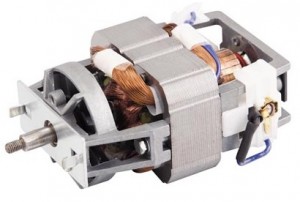
Related image
(Image of the motor of a Food Processor.)

The Feed Tube
As mentioned earlier, a feed tube allows to load the food contents in the bowl. Therefore, a feed tube should be wide in size. A lid with narrow feed tube often requires pre-cutting of many food items by hand before they can be loaded into the bowl or one would have to remove the lid altogether, to load the larger food items directly into the bowl. This could become cumbersome when food items need to be loaded into the bowl more than once.

The Attachments
This is one of the most important components of a food processor. Without having the proper set of attachments to cater to one’s intended use, no matter how capable the motor or how durable the bowl is, they would not be of much use.
The attachments that are generally required to cater to the Indian cooking conditions are:-

Standard attachments
  • S-shaped blade. Also known as the Sabatier blade, this blade sits at the bottom of the bowl and comes as standard in every food processor and is good for performing average tasks like chopping and mincing. Additionally, the sabatier blade can also be used for kneading the dough, however, the kneaded dough is not as even, as obtained by using a dedicated kneading attachment.
Specialized attachments
  • Shredding, Slicing and Grating discs. These three attachments are made of metal and sit at the top of the bowl over the shaft. They work in similar ways, though they solve different purposes. Through the feed tube, food item is pushed in the bowl where it makes contact with the rotating disc and gets shredded or sliced or grated into finer pieces, depending upon which of these three attachments is used. The finer pieces of food obtained, get collected in the bowl.
  • Dough blade. This attachment is made of plastic and has straighter paddles than the S-shaped blade. This allows the blades to do a better job at kneading the dough rather than just slicing through it, which happens in the case of S-shaped blade.
  • Blender. This attachment is in the form of a jug and fits onto the shaft, right in the place where the bowl fits and is used to make milkshakes, smoothies, etc.
  • Citrus press or juicer. This attachment is dome-shaped and sits at the top of the shaft. When a fruit is pressed along the rotating dome, the pulp of the fruit gets removed and is collected in the bowl.
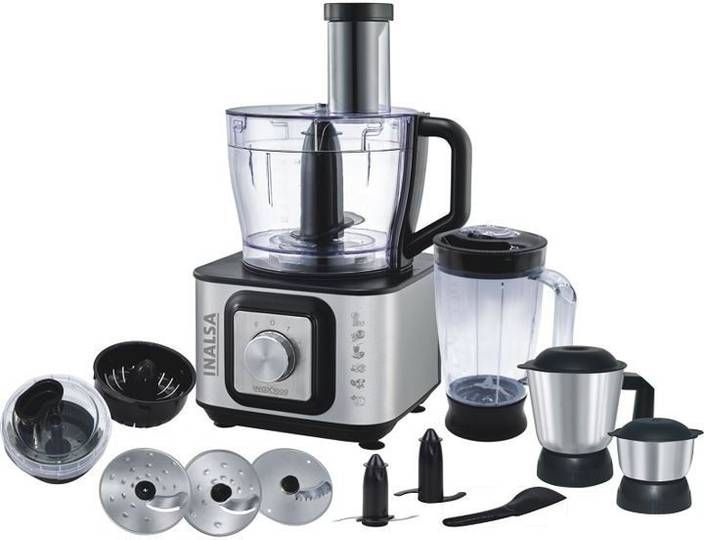
Inalsa Inox 1000 1000 W Food Processor
(Image of the several attachments of a food processor)

Now having understood about the different components of a food processor and the various types of attachments that perform specific functions on the food items, let us proceed to discuss the ways in which some manufacturers try to cut manufacturing costs and maximize their own profits and in turn deliver a sub-standard product to the customers, the motor and blades/attachments of which have a very short shelf life.

COST CUTTING TECHNIQUES
  • Poor quality overheating motor. The motor of a food processor is one of its most important components and covers almost 30 percent the cost of the entire food processor unit. Hence, it is one of the favourite areas of some manufacturers to cut costs and increase their profit margin. The inefficient motor deployed by some manufacturers tends to get extremely warm only after a few minutes of spinning. As you might be aware that metals expand on heating, which causes the copper windings in the motor to initially distort and then finally melt, thereby leaving the entire food processor unit, out of operation. Cost of repairing the motor might range from a few hundred bucks to more than a thousand bucks and this process is recurring.
  • Inefficient blades and attachments. The quality, sharpness and durability of the blades and attachments are often overlooked by many customers. This gives some manufacturers a perfect opportunity to cut costs. What those manufacturers do is, instead of actually making use of high quality razor-sharp stainless steel blades in the food processor, they tend to merely polish the ordinary blades to make them look like they are of great quality and can cut through any food item. However, in reality, the shine and the sharpness of those poor quality blades wear off within two to three months of use. Following which, customers have to get the blades replaced and this process goes on.


Now, having learnt about how some food processor manufacturers cut costs, let us proceed to zero down on some of the best built food processors, both in terms of the quality of the attachments used and the build quality of the outer body. The food processors mentioned below make use of high quality materials both for the motor as well as the blades and are also energy efficient in their working and thus offer great value for the money spent.


Wednesday, 20 December 2017

What you should know before buying a refrigerator?

Author- Vibhor Shergill (Brother of Sabhyata Shergill)

[Last Updated: 7th August, 2021]

With the global temperatures showing a steady rise, humans are resorting to visiting and working at places that have an effective air conditioning system. The reason is simple, the human body works efficiently when the surrounding temperatures are between 15 degree and 35 degree Celsius. Any more than that takes a toll on our productivity. Similarly, the food that we consume also has a temperature range at which it provides the most nutritional value. Most cooked food items need to be stored at temperatures below 10 degree Celsius for them to remain fresh and to prevent the growth of bacteria and fungi on them. This is when a refrigerator comes to the rescue.

Now, if you are a frequent visitor to the posts on this blog, you might be probably aware that we take each topic from the grass root level and we will do the same with this post as well. We will begin with the basics first, understand how a refrigerator works. Then, we will discuss what capacity of refrigerator one should purchase as per one's requirements. After that we will proceed onto discussing the essential features one should look for when buying a refrigerator. Following which, we will learn how some brands try to cut costs and manufacture below par products that delay the cooling process and have frequent refrigerant leaks. Then, we will move onto deciding which are the best refrigerators available in the market that are not only efficient in their operation but also offer the most value for money.

You might be glad to know that my father works at a company that manufactures home and kitchen appliances like washing machines, refrigerators, cooking appliances, food processors, kitchen chimneys etc. So, at home, we frequently have a conversation about these appliances, what goes into making them, how some brands try to cut manufacturing costs to increase their profit margin etc.
Today, I will try my best to pass on the knowledge that I have acquired from my father over the years, to you so as to help you make a good buying decision.

So without further a do, let’s begin…

Related image

THE BASICS

A refrigerator works on the principle of evaporation. The principle states that when a liquid evaporates, it absorbs heat in the process. A refrigerator consists of a coolant called as refrigerant which is trapped inside a series of coils. As the refrigerant makes its way through the coils, it repeatedly transforms from liquid state to gaseous one.

A refrigerator mainly consists of four major components, namely:-
  • Expansion valves
  • Compressor
  • Radiator pipes
  • Condenser
The refrigeration process begins with the liquid refrigerant entering the expansion valves. As it passes through, the sudden drop in pressure expands the liquid and turns it into gas. The compressor takes in the gas refrigerant and squeezes it, thus raising its temperature and pressure. The hot, pressurized refrigerant gas flows through the thick and rounded copper radiator pipes which are present at the back of the refrigerator. As the gas passes through the radiator pipes, it cools down quickly and turns back into its liquid state. The cooled liquid refrigerant then flows back into the condenser and the process starts again.

Now, having discussed how a refrigerator works, let us proceed to discuss the capacity of refrigerator that would be best suited for your home as per your requirements:-
  • For bachelors. If you stay in a flat or as a paying guest with a few room mates and mostly you store pouches of milk, eggs, curd, water bottles, loaves of bread in your refrigerator etc. The maximum capacity of refrigerator you would need is 190L.
  • For a nuclear family consisting of 3 to 4 family members and you wish to store healthy quantity of food items in your refrigerator including vegetables, dairy products, non-vegetarian products, juice cans etc. The capacity of the refrigerator you should aim for is 350L.
  • For a joint family having 5 to 8 family members and you require a refrigerator to store a lot of food items, most of them including fresh vegetables, non-vegetarian food items like fish, chicken etc and you do not store food for longer periods and consume the stored items in a day or two. In this case, go for at least a 440L capacity refrigerator.
  • For a large joint family with more than 8 members. Keeping this into consideration, you require to store a lot of food items in your refrigerator, from non-vegetarian content to dairy products to eggs to soft drink bottles etc., and prefer to keep most of the food items in deep freeze mode so as to consume only a small part of it daily and store the rest for the days to come. In this case, choosing a double door refrigerator with at least 600L capacity would be a wise decision.
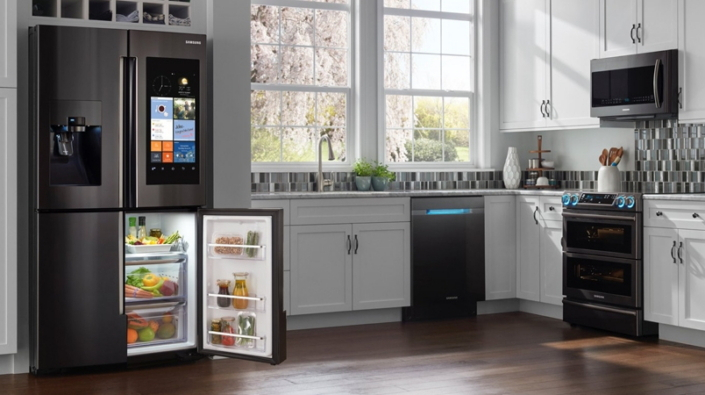
Related image
(Image of the inside view of a refrigerator)

So, having learnt what capacity of refrigerator one should purchase depending upon one's requirements, let us proceed to discuss some of the crucial features that one should look for when buying a refrigerator:-
  • Inverter Compressor Technology: More durable and consumes lesser electricity in comparison to a reciprocating compressor.
  • At least a 3 Star rating: For Energy savings up to 35%.
  • Frost Free: Auto fridge defrost to stop ice-build up.
  • Built in Stabilizer: No need to purchase a separate voltage stabilizer.
Now, having discussed what features one should look for when buying a refrigerator, let us proceed to discuss the ways in which some manufacturers (names not taken) try to cut manufacturing costs to maximize their own profits and in turn deliver a sub-standard product to the customers which has a very short shelf life and may prove to be hazardous to the users.

COST CUTTING TECHNIQUES

  • Poor fabrication of condenser coils leading to refrigerant leaks. Condenser coils are one of the most important aspects of a refrigerator as they contain the liquid refrigerant and account for almost 30 to 35 per cent of the entire cost of the refrigerator. Needless to say, the condenser coils are one of the favourite areas of the manufacturers to make huge profits. Some manufacturers resort to using poor grade copper condenser coils that develop minute holes and cracks over a period of time that lead to refrigerant leak which may prove to be dangerous to humans if inhaled in excess.
  • Improper insulation. Keeping the contents of the refrigerator sealed from outside hot temperatures is a very essential aspect of refrigeration. To ensure proper insulation, high quality door seals must be used. However, most people do not pay much attention to the insulation aspect of the refrigerator while buying it. Hence, door seal becomes another major area where some manufacturers cut costs. A poor door seal deployed by those manufacturers does not completely attach itself to the body of the refrigerator which leads to very minute gaps between the seal and the body. As a result, hot air from outside continuously seeps inside the refrigerator causing the food contents to get spoiled.


Archive

 Constant Contact -  https://constant-contact.ibfwsl.net/b34r4B